Pioneering climate action: Grundfos launches electric truck deployment with Maersk
 LinkedIn
 Facebook
 X.com
X.com
 WeChat
 Email
Email
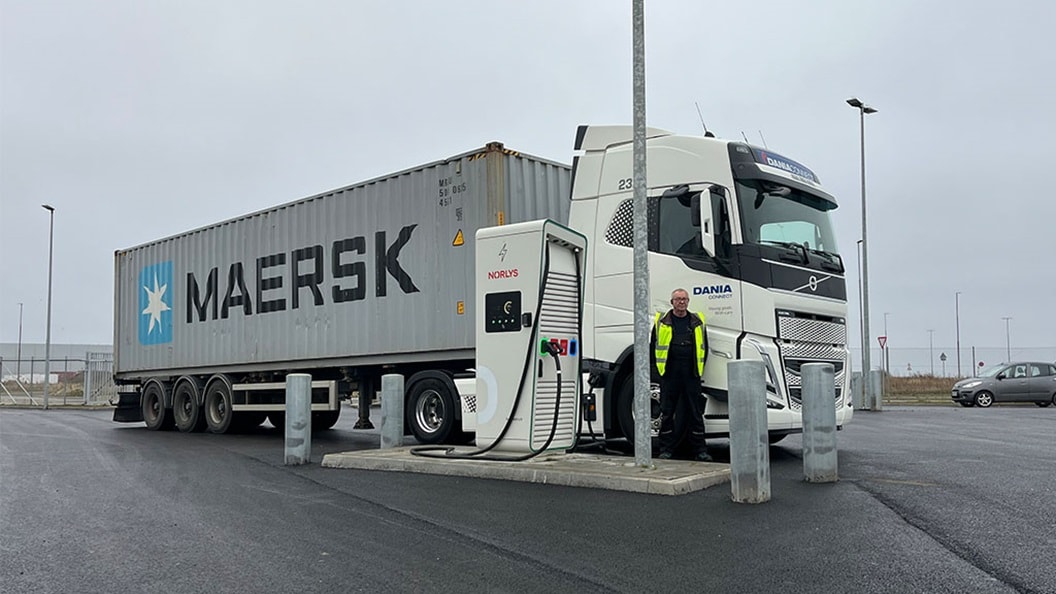
Copenhagen/Bjerringbro, Denmark – Every single day, thousands of containers are transported globally by truck for hinterland haulage – to and from ports, between factories and warehouses, or on the last mile to their final destination. The countless road transports not only cause greenhouse gas emissions, but also harmful exhaust fumes and noise emissions for people and animals.
This makes the conversion of truck fleets worldwide to electric trucks (EV trucks) one of the most important and, at the same time, one of the most difficult tasks in logistics. The challenges are many: e-trucks cost up to three times as much as conventional diesel trucks, their range is significantly shorter and suitable charging infrastructure is still lacking in almost all countries. In addition, customers must be prepared to pay a surcharge for road transport with lower climate impact due to the additional costs.
"This is a gigantic task, but we must not be intimidated by it," says Birna Odefors, Managing Director of Maersk Area Nordics, which is home to a particularly large number of customers who are among the pioneers of decarbonised logistics.
One of Maersk's Danish pioneer customers is Grundfos. The Danish engineering company, that specialises in advanced pump solutions and water technology, is now using Maersk's electric truck offering, where containers are transported between their factory and the port of Aarhus by an electric truck. The pilot transports have been running since October 2024 and are to be ramped up to around 600-800 containers per year in the future.
Since 2020, Grundfos has been one of the first customers to ship their seaborne containers with fuels with lower climate impact with Maersk. Today, Grundfos already uses this ECO Delivery Ocean product for 100% of its ocean freight under Maersk care. The use of a mix of alternative marine fuels such as waste-based biodiesel and bio-methanol reduces Greenhouse Gas (GHG) emissions by up to 80% compared to fossil marine bunker oil. With the electric road transports, which are now being added, the direct tailpipe emissions of the trucks are completely eliminated, as the electric truck is charged exclusively with renewable electricity.
After ocean freight port to port reduction, we really wanted to take the next step and also save emissions in pre-carriage of containers as well as the last mile to our plants or warehouse sites. The implementation of EV trucks on the roads in Denmark went very well and this is a good case for international expansion of EV trucks. In view of the dire climate consequences that we can see in the news almost every day, we cannot wait and must take action wherever we can. We as producers and exporters want to actively drive the topic of decarbonization of the supply chain and are pleased to partner with Maersk who is willing to try and implement new ways.
Maersk aims to significantly reduce its GHG emissions from all modes of transport and its more than 500 logistics centers worldwide by 2030. Maersk’s net zero target is the year 2040. Grundfos aims to achieve net-zero emissions by 2050 and also has, same as Maersk, ambitious interim targets for 2030.*
* Grundfos and Maersk have both received full validation of their net-zero pathways from the Science-Based Targets initiative (SBTi), a climate action organisation that enables companies to set greenhouse gas (GHG) emissions reduction targets grounded in science.
About Grundfos
Grundfos pioneers solutions to the world’s water and climate challenges and improves the quality of life for people. As a leading global pump and water solutions company, we promise to respect, protect, and advance the flow of water by providing energy and water efficient systems and solutions for a wide range of applications for water utilities, industries and buildings.
Find out more: Grundfos.com
About Maersk
A.P. Moller - Maersk is an integrated logistics company working to connect and simplify its customers’ supply chains. As a global leader in logistics services, the company operates in more than 130 countries and employs around 100,000 people. Maersk is aiming to reach net zero greenhouse gas (GHG) emissions by 2040 across the entire business with new technologies, new vessels, and reduced GHG emissions fuels. (Maersk defines reduced / lower GHG emissions fuels as fuels with at least 65% reductions in GHG emissions on a lifecycle basis compared to fossil of 94 g CO2e/MJ)
For further information, please contact:

我們隨時為您提供協助,滿足您的各種需求

解決方案

聯絡我們

準備出貨?
I agree to receive logistics related news and marketing updates by email, phone, messaging services (e.g. WhatsApp) and other digital platforms, including but not limited to social media (e.g., LinkedIn) from A. P. Moller-Maersk and its affiliated companies (see latest company overview). I understand that I can opt out of such Maersk communications at any time by clicking the unsubscribe link. To see how we use your personal data, please read our Privacy Notification.
By completing this form, you confirm that you agree to the use of your personal data by Maersk as described in our Privacy Notification.