Maersk becomes first to have climate targets validated by SBTi under the new Maritime Guidance
 LinkedIn
 Facebook
 X.com
X.com
 WeChat
 Email
Email
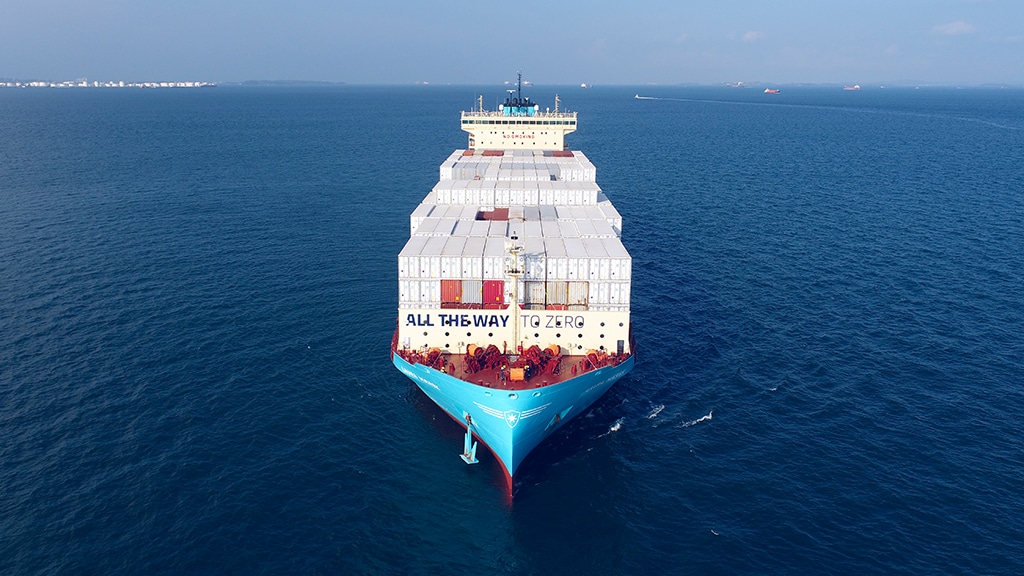
Copenhagen - A.P. Moller - Maersk´s (Maersk) greenhouse gas emissions targets have been validated by the Science Based Targets initiative (SBTi) to be in line with the 1.5-degree pathway from the Paris Agreement. This marks an industry first under SBTi’s new Maritime Guidance.
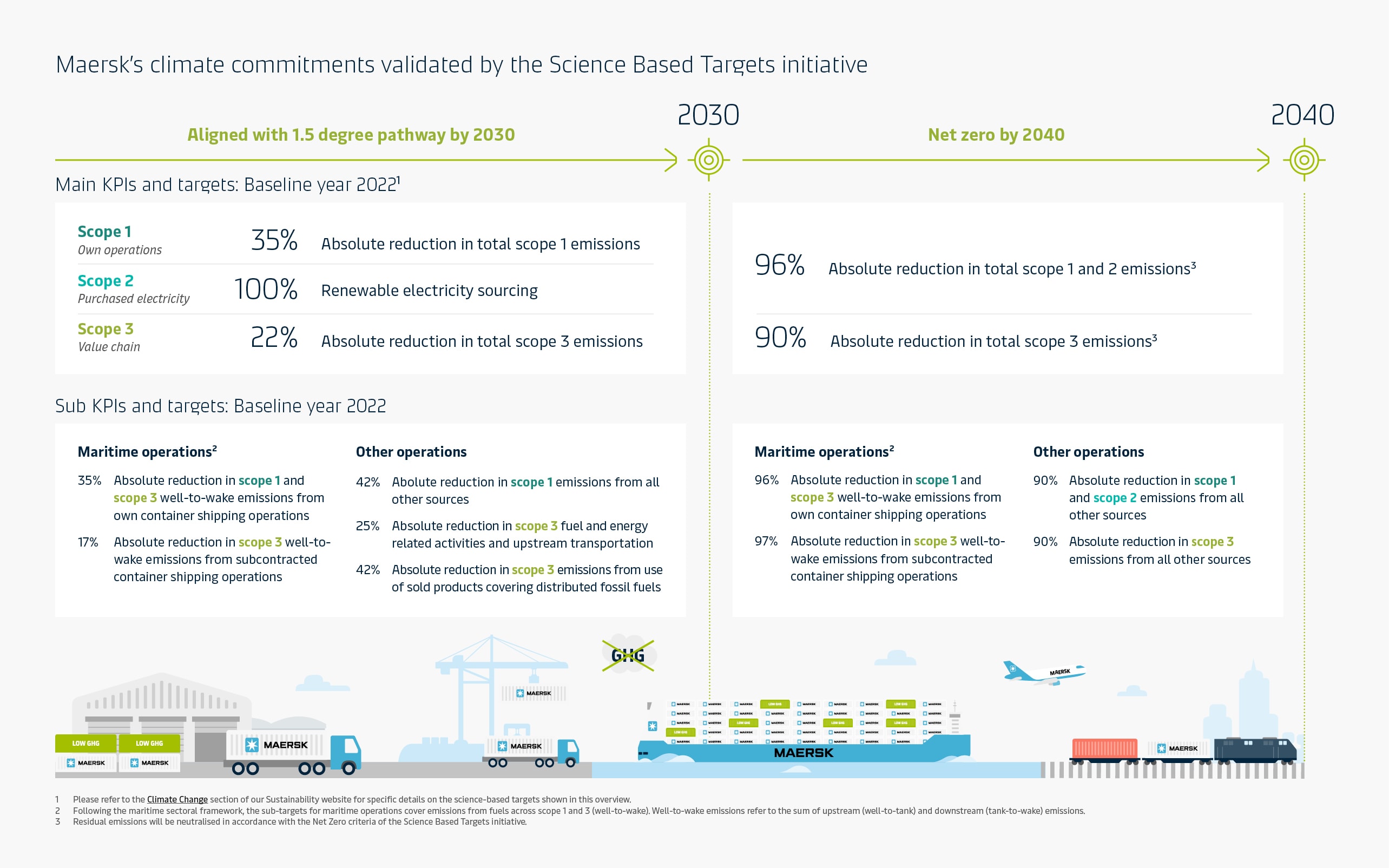
While Maersk continues to aim for Net-Zero* greenhouse gas (GHG) emissions for the entire business in 2040 with significant milestones for 2030, the validated targets include new specific and absolute targets to reduce emissions from Maersk’s own operations and across its supply chains (covering all scope 1, 2 and 3 emissions).
At Maersk, we feel a strong responsibility to take action in the climate crisis. The Science Based Targets initiative represents the highest standard for corporate climate targets, and we are very proud to have obtained validation. We are committed to do our share to reach these targets, but we cannot do it alone. To succeed, we are dependent on and working with the ecosystem that we are part of, including customers, suppliers, industry peers and regulators. Importantly, there is a need for global regulations from the International Maritime Organization (IMO) to close the price gap between fossil and green fuels to secure a level playing field,
These new targets are a proof-point that even as a company in a hard–to-abate sector, it is possible to adopt ambitious science-based targets and get them validated. We know that delivering on them will be a very difficult task, however, setting ambitious targets, both near- and long-term, is critical to our energy transition efforts as they drive action to secure material impact in this decade.
Maersk and the wider maritime sector are working intensely to drive an effective implementation of the International Maritime Organization’s Greenhouse Gas Strategy. As green fuels** come with a higher price than fossil fuels, a regulatory regime accelerating the energy transition of the sector and covering the majority of the cost gap for green fuels is paramount. In this context, Maersk, along with its industry peers in the World Shipping Council, will put forward a concrete green balance proposal at IMO MEPC81 addressing this.
Today, almost 60% of Maersk’s top 200 customers have committed to or set science-based targets, including their supply chains. A Green Balance Mechanism for shipping will support their efforts to decarbonise their logistics supply chains as well as help the shipping industry reach net-zero emissions.
Within the company's own operations, the most important levers are green fuels and continued improvements in fuel efficiency, while solutions across the supply chain require engagement and close collaboration with suppliers.
In the 2023 Sustainability Report, Maersk reports on its existing climate targets. From 2024, Maersk will commence reporting on the new SBTi validated targets.
*Net-Zero is defined as:
Reducing scope 1, 2, and 3 emissions to zero or to a residual level that is consistent with reaching net-zero emissions at the global or sector level in eligible 1.5°C-aligned pathways and neutralising any residual emissions at the net-zero target year and any GHG emissions released into the atmosphere thereafter.
** Maersk defines green fuels as:
Maersk defines “green fuels” as fuels with low to very low GHG emissions over their life cycle compared to fossil fuels. Different green fuels achieve different life cycle reductions, depending on their production pathway. By 'low' we refer to fuels with 65-80% life cycle GHG reductions compared to fossil fuels. This covers, e.g., some biodiesels. ”Very low” refers to fuels with 80-95% life cycle GHG reductions compared to fossil fuels.
Fact Book – A.P. Moller – Maersk’s validated targets
Overall Net-Zero Target
- To reach net-zero greenhouse gas emissions across the value chain by 2040 from a 2022 base year.
Near-Term Targets - 2030
- To reduce absolute scope 1 GHG emissions 34.7% by 2030 from a 2022 base year.**
- To reduce absolute scope 3 GHG emissions 21.9% within the same timeframe.
- To reduce absolute well-to-wake scope 1 and 3 GHG emissions from container shipping operations 34.7% by 2030 from a 2022 base year.
- To reduce absolute scope 1 GHG emissions from all other sources 42% within the same timeframe.
- To reduce absolute well-to-wake scope 3 GHG emissions from subcontracted container shipping operations 16.7% within the same timeframe. Furthermore,
- To reduce absolute scope 3 GHG emissions from use of sold products covering distributed fossil fuels 42% within the same timeframe.
- To reduce remaining absolute scope 3 GHG emissions from fuel and energy related activities and upstream transportation and distribution 25% within the same timeframe.
- To increase annual sourcing of renewable electricity from 22.7% in 2022 to 100% by 2030.
Long-Term Targets - 2040
- To reduce absolute scope 1 and 2 GHG emissions 96% by 2040.*
- A.P. Moller-Maersk also commits to reduce absolute scope 3 GHG emissions 90% within the same timeframe.
- To reduce absolute well-to-wake scope 1 and 3 GHG emissions from container shipping operations 96.2% by 2040 from a 2022 base year.
- To reduce absolute scope 1 and scope 2 GHG emissions from all other sources 90% within the same timeframe.
- To reduce absolute well-to-wake scope 1 and 3 GHG emissions from subcontracted container shipping operations 97.1% within the same timeframe. Furthermore,
- To reduce remaining absolute scope 3 GHG emissions 90% within the same timeframe.
** The target boundary includes biogenic land-related emissions and removals from bioenergy feedstocks.
About the Science Based Targets initiative
The Science Based Targets initiative (SBTi) is a global body enabling businesses to set ambitious emissions reductions targets in line with the latest climate science. It is focused on accelerating companies across the world to halve emissions before 2030 and achieve net-zero emissions before 2050.
The initiative is a collaboration between CDP, the United Nations Global Compact, World Resources Institute (WRI) and the World Wide Fund for Nature (WWF) and one of the We Mean Business Coalition commitments. The SBTi defines and promotes best practice in science-based target setting, offers resources and guidance to reduce barriers to adoption, and independently assesses and approves companies’ targets.
About Maersk
A.P. Moller - Maersk is an integrated logistics company working to connect and simplify its customers’ supply chains. As a global leader in logistics services, the company operates in more than 130 countries and employs around 100,000 people. Maersk is aiming to reach net zero GHG emissions by 2040 across the entire business with new technologies, new vessels, and reduced GHG emissions fuels*.
*Maersk defines "reduced GHG emissions fuels" as fuels with at least 65% reductions in GHG emissions on a lifecycle basis compared to fossil of 94 g CO2e/MJ.
For further information, please contact:

我們隨時為您提供協助,滿足您的各種需求

解決方案

聯絡我們

準備出貨?
I agree to receive logistics related news and marketing updates by email, phone, messaging services (e.g. WhatsApp) and other digital platforms, including but not limited to social media (e.g., LinkedIn) from A. P. Moller-Maersk and its affiliated companies (see latest company overview). I understand that I can opt out of such Maersk communications at any time by clicking the unsubscribe link. To see how we use your personal data, please read our Privacy Notification.
By completing this form, you confirm that you agree to the use of your personal data by Maersk as described in our Privacy Notification.