Maersk names its 11th dual-fuel Methanol vessel ‘Albert Maersk’ in Mumbai
 LinkedIn
 Facebook
 X.com
X.com
 WeChat
 Email
Email
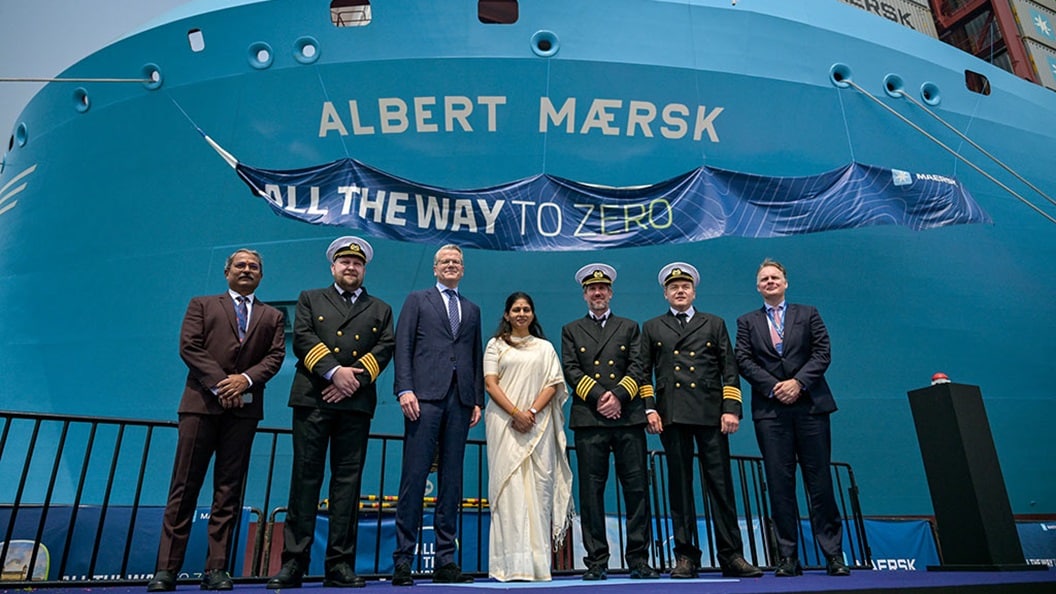
As the Godmother, State Minister Raksha Khadse christens the vessel during Maersk’s first-ever name-giving ceremony in India at APM Terminals Mumbai.
Mumbai: A.P. Moller - Maersk (Maersk) celebrated the name-giving of its newest dual-fuel methanol container vessel in Mumbai today as a part of the vessel’s maiden voyage to India. The vessel, named Albert Maersk, is the eleventh vessel in Maersk’s fleet capable of operating on methanol.
Vincent Clerc, CEO, A.P. Moller - Maersk, hosted the name-giving ceremony, which was attended by the Honourable Minister of Ports, Shipping and Waterways, Sarbananda Sonowal, the Honourable Minister of State for Youth Affairs and Sports, Raksha Khadse, diplomats, government authorities, customers, partners and Maersk employees.
It is a privilege for India to host the naming of this advanced dual-fuel vessel, a historic first for a foreign shipping company in our country. With the demand for green vessels rising, India has the potential to become a major producer and supplier of green methanol, ammonia, and hydrogen-based fuels. Maersk’s decision to focus on green fuel production in India is a welcome step that will accelerate our journey towards a sustainable maritime future. This vessel naming is more than just a tradition—it is a symbol of trust, collaboration, and a shared vision for the future. As India moves towards becoming a global maritime powerhouse, we welcome Maersk’s continued partnership in green shipping, green fuel production, and logistics.
Maersk continues to take firm steps towards decarbonising shipping with the addition of one more dual-fuel vessel to its fleet. India is among the world's fastest-growing major economies, with a thriving manufacturing sector, a booming e-commerce industry, and expanding exports. Shipping and logistics are high on India’s priorities, and Maersk looks forward to partnering with India on various aspects, such as exploring the potential sourcing of alternative fuels for low-emissions shipping and activities involving ship repairs and shipbuilding in the future that align well with the Indian Government’s ambitions to promote the shipping sector.
Maersk contributes to this growing economy by facilitating the movement of one in every six containers imported or exported from the country and enabling global trade through its integrated logistics solutions. The company’s footprint in India includes two APM Terminals operations in Mumbai and Pipavav that facilitate the import and export of over three million containers every year, 26 warehouses spread across 350,000 sq. m., and a distribution network that reaches more than 80% of India's pin codes.
On the backdrop of the name-giving ceremony, Maersk announced that the company sees an investment opportunity pipeline of about USD 5 billion in ports and terminals as well as landside infrastructure development in India.
We believe we can play a role in reducing the cost of logistics by ensuring that our customers access all their supply chain needs in one place – from all modes of transportation to port handling to warehousing and distribution. As APM Terminals, we are ready to invest more in developing ports with low emissions and great efficiency that will help businesses grow and connect India with the global markets.
‘Albert Maersk’ is part of a series of 18 large dual-fuel methanol vessels scheduled for delivery in 2024 and 2025. Built at Hyundai Heavy Industries in Ulsan, South Korea, she can carry 16,592 standard containers (TEU). The delivery of the dual-fuel fleet is a significant component of Maersk’s decarbonisation goal of achieving net-zero greenhouse gas (GHG) emissions by 2040. Bio- and e-methanol can reduce GHG emissions by at least 65% compared to conventional fossil fuels such as bunker oil (depending on the feedstock and production process of the methanol, calculated on a life cycle basis). With the vessel technologies available, Maersk has been urging the International Maritime Organisation (IMO) member states to adopt strong regulations to push the industry forward towards its climate targets. Maersk believes it is critically important that IMO regulation is fuel-agnostic, allowing for a multi-fuel future for shipping as well as making the low-emission transport choice viable and competitive by closing the price gap between fossil and alternative fuels.

About Maersk
A.P. Moller - Maersk (Maersk) is an integrated logistics company connecting and simplifying its customers’ supply chains. As a global leader in logistics services, the company has 100,000+ customers, operates in almost 130 countries, and employs 100,000+ people. Maersk delivers innovative, reliable ocean network solutions, offers truly integrated logistics products and operates advanced container terminals, both gateways and hubs, with 60+ locations globally.
For further information, please contact:

About APM Terminals
APM Terminals develops and operates advanced container terminals around the world and has been lifting standards in the industry for more than a half century. The company is an independent division in A.P. Moller - Maersk, and has facilities in 60 key locations in 33 countries around the globe – with several in development. Approximately 33,000 people work for APM Terminals, and in 2024, there were +27,000 vessel calls and 23.2 million moves in its hubs and gateway terminals.
Anything you need, we’re here to help

Logistics services

Contact us

Ready to ship?
I agree to receive logistics related news and marketing updates by email, phone, messaging services (e.g. WhatsApp) and other digital platforms, including but not limited to social media (e.g., LinkedIn) from A. P. Moller-Maersk and its affiliated companies (see latest company overview). I understand that I can opt out of such Maersk communications at any time by clicking the unsubscribe link. To see how we use your personal data, please read our Privacy Notification.
By completing this form, you confirm that you agree to the use of your personal data by Maersk as described in our Privacy Notification.