Maersk employees innovate a system to deliver fresh water from Maersk’s vessels to ports
 LinkedIn
 Facebook
 X.com
X.com
 WeChat
 Email
Email
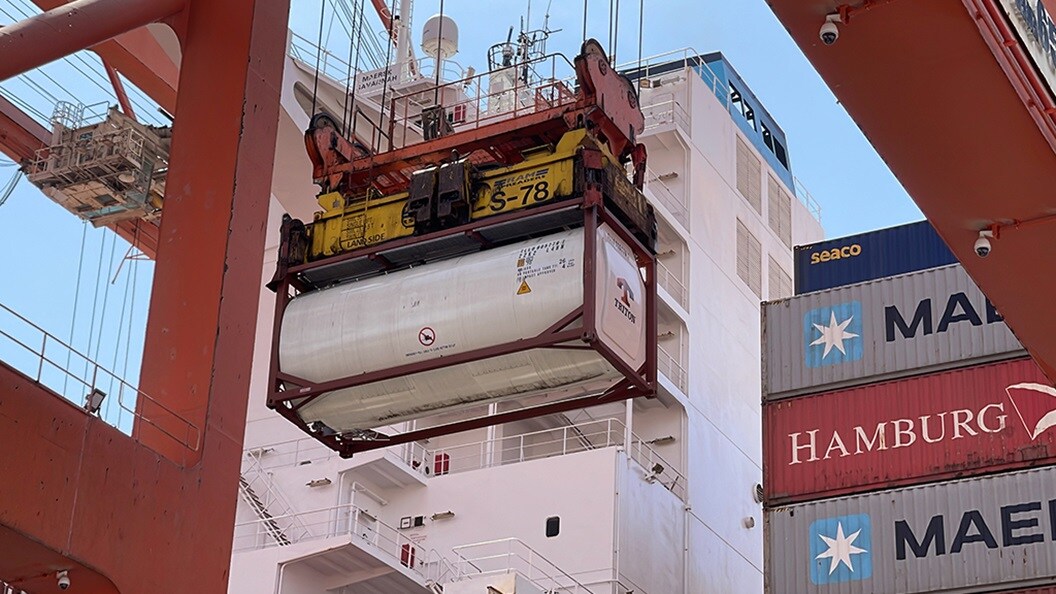
The pioneering project optimises an existing fresh water generation system onboard container vessels to further store and deliver it in tank containers to ports and regions facing scarcity of fresh water.
Salalah: Fresh water scarcity is an increasing problem faced by regions all over the world. Four billion people — almost two-thirds of the world’s population — experience severe water scarcity for at least one month each year, and half of the world’s population could be living in areas facing water scarcity by as early as 2025*. With this background, a team of three employees of A.P. Moller – Maersk (Maersk), who are former seafarers, decided to undertake an innovative project that could store and deliver fresh water from vessels to ports.

Cargo ships undertaking global trade are equipped with fresh water generator systems that produce clean drinking water by distilling sea water using heat energy harnessed from their engines. Traditionally, this system has been used to generate water for consumption only onboard the vessels. However, the excess water produced has been overlooked. Through this innovative project, this untapped resource has been capitalised on by optimising the process and storing the excess water in tank containers before delivering it to ports.
Each vessel can fill two tank containers on an average sea voyage between two ports. With the process optimised and tank containers stored at the right location onboard, two tank containers with a combined capacity of 50,000 litres can be filled with fresh water. Amongst the first pilot runs were the deliveries at the Port of Colombo and Port of Salalah of two tank containers, each filled with 25,000 litres of fresh water.
At Port of Salalah, sustainability is one of our top priorities and are committed to decarbonising our operations by 2040. We also recognise that sustainability is not only about decarbonising supply chains but also protecting our environment and its finite resources. The first tank container of fresh water delivered by Maersk from its vessel is an important milestone that has the potential to pave the path for a larger scheme of things. This project opens doors for many more ships moving around the world, which can replicate this system and create an incredibly large supply of fresh water that is being delivered all around the world to address the ever-increasing challenge of water scarcity.
A pivotal aspect of the project's success is its rigorous adherence to quality and environmental standards. The water quality, tested by the Ceylon Institute of Scientific & Industrial Research, an official Sri Lankan Government laboratory, met all World Health Organisation (WHO) standards, underscoring the project's commitment to safety and sustainability. Furthermore, a Life Cycle Assessment (LCA) study conducted by the Danish Technical University has provided valuable insights into the project's environmental impact, comparing it favourably against traditional tanker truck water delivery methods.
The fresh water generated and delivered through this innovative project can be used in various ways:
- Consumption at port facilities for basic sanitation, cleaning, and maintenance of offices, warehouses, and restrooms.
- Ship repair at yards for tasks like cleaning vessels, tools, and work areas.
- Container washing before storage or reusing.
- Firefighting at port facilities for emergencies.
- Power generation at power plants located in ports for cooling systems or other processes.
Additionally, this fresh water can also be distributed for humanitarian activities by transporting it to the hinterland for use by societies facing water scarcity.
The possibility to generate, store and deliver fresh water from our ships presents a unique opportunity to address water scarcity. The successful conclusion of the pilot deliveries is a testament to the innovative capabilities and perseverance of our team. The next step for us would be to explore the possibilities of expanding our efforts to more ports and collaborate with beneficiary stakeholders worldwide. Together, we could make a significant impact by improving the access to clean drinking water for communities in need, too.
*As reported by UNICEF
About Maersk
A.P. Moller - Maersk (Maersk) is an integrated logistics company connecting and simplifying its customers’ supply chains. As a global leader in logistics services, the company has 100,000+ customers, operates in almost 130 countries, and employs 100,000+ people. Maersk delivers innovative, reliable ocean network solutions, offers truly integrated logistics products and operates advanced container terminals, both gateways and hubs, with 60+ locations globally.
For further information, please contact:

Anything you need, we’re here to help

Logistics services

Contact us

Ready to ship?
I agree to receive logistics related news and marketing updates by email, phone, messaging services (e.g. WhatsApp) and other digital platforms, including but not limited to social media (e.g., LinkedIn) from A. P. Moller-Maersk and its affiliated companies (see latest company overview). I understand that I can opt out of such Maersk communications at any time by clicking the unsubscribe link. To see how we use your personal data, please read our Privacy Notification.
By completing this form, you confirm that you agree to the use of your personal data by Maersk as described in our Privacy Notification.